Your Cart (0)
Your cart is empty
Taxes included in the price
Your routine can start here



Drawer menu
Taxes included in the price
The best hair transplant shampoo is a specific dermo-cosmetic shampoo, not a conventional shampoo. It should have a physiological pH, contain no harsh surfactants or irritating ingredients, and be formulated for the care of a sensitive scalp and transplanted hair — both in the first few weeks and for regular use afterwards.
In 30 seconds
If you just want a quick answer, a hair transplant shampoo should meet these criteria:
Before focusing on a specific brand, these are the criteria that many hair transplant clinics recommend, and that are typically considered in dermo-cosmetic formulation for sensitive scalp after a hair transplant. A conventional shampoo isn't formulated with these criteria in mind, because it isn't designed for an altered scalp.
| Criterion | Importance | Why it matters |
|---|---|---|
| Physiological pH (4.5–5.5) | ⭐⭐⭐⭐⭐ | Respects the scalp's acid mantle and barrier function |
| No harsh surfactants | ⭐⭐⭐⭐⭐ | Reduces the risk of irritation on a scalp that is more sensitive after the procedure |
| No irritating ingredients or strong fragrances | ⭐⭐⭐⭐ | Lower likelihood of reactions on sensitised skin |
| Ingredients that help maintain the skin barrier | ⭐⭐⭐⭐⭐ | Help maintain the barrier function of a sensitive scalp |
| Specific dermo-cosmetic formulation | ⭐⭐⭐⭐ | A product reviewed or recommended by professionals offers more assurance than a generic one |
| Designed for regular use, not just short-term | ⭐⭐⭐⭐⭐ | Transplanted hair needs ongoing care, not just during the first few weeks |
This guide explains how to compare the different options. If you're looking for practical guidance on which type of shampoo to use and when to start, see our guide on what shampoo to use after a hair transplant .
The scalp naturally maintains a slightly acidic pH, usually around 4.5–5.5. Neutral pH is 7, a more alkaline value than that natural balance. The scalp's acid mantle acts as a protective barrier: shampoos formulated within the physiological range respect it better than those formulated at a neutral pH, which tends to disrupt it and can lead to dryness, itching or flaking. That's why a specific hair transplant shampoo is formulated within that range — rather than simply being labelled "neutral" — which is especially relevant on a scalp that is already more sensitive from the start after the procedure.
| Feature | Conventional shampoo | Hair transplant shampoo |
|---|---|---|
| Physiological pH (4.5–5.5) | Sometimes | Yes |
| Harsh surfactants | May contain | No |
| Irritating ingredients | May contain | No |
| Suitable for sensitive scalp | Not necessarily | Yes |
| Designed for regular, ongoing use | Not specifically | Yes |
The exact timing for the first wash and how to use the shampoo afterwards is determined by the medical team or clinic that performed the procedure. A hair transplant shampoo formulated within the physiological range can be used both to prepare the scalp before the transplant and to accompany the regular routine of transplanted hair afterwards, without being limited to a specific time window.
This guide is based on common recommendations from hair transplant clinics, a review of the scientific literature on skin barrier function and dermo-cosmetic formulation, and formulation criteria for sensitive scalp (pH, surfactants, ingredients). It doesn't replace individual medical advice: if you have any specific questions about your case, consult your clinic or medical team.
Last updated: July 2026.
A dermo-cosmetic shampoo with a physiological pH (4.5–5.5), free from harsh surfactants and irritating ingredients, specifically formulated for sensitive scalp and transplanted hair. A conventional shampoo isn't designed for this specific need.
The same criteria apply regardless of terminology: physiological pH, no harsh surfactants, and a formula designed for sensitive scalp care. The term used may vary by clinic, but the need for proper care is the same.
The timing of the first wash is set by the medical team or clinic, since it depends on the technique and each individual case. A shampoo formulated for hair transplants can be used from that first wash and continued afterwards as part of your regular routine.
It's not recommended. A conventional shampoo may contain harsh surfactants or an unsuitable pH for a scalp that's more sensitive, which can contribute to itching, redness or tightness. A specific hair transplant shampoo reduces that risk.
Itching is usually related to scalp sensitivity after the procedure. A shampoo with physiological pH and no harsh surfactants helps avoid adding further irritation. If itching persists or worsens, it's worth checking with your clinic.
Physiological pH (4.5–5.5) respects the scalp's natural balance. A pH that's more alkaline than usual disrupts the acid mantle and increases sensitivity, itching and irritation in an area that, after a hair transplant, is already more reactive than normal.
No. Neutral pH is 7; the scalp's physiological pH is between 4.5 and 5.5, meaning it's slightly acidic. A shampoo formulated within that range respects the skin's acid mantle better than one simply labelled "neutral".
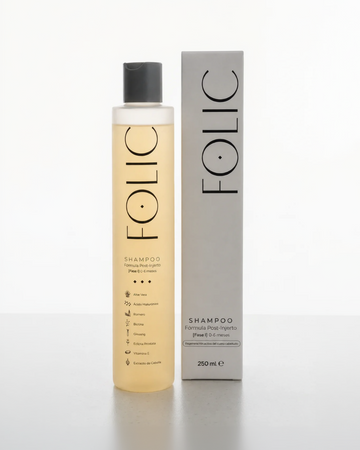
Yes. FOLIC is formulated to prepare the scalp before a hair transplant and to support the care of transplanted hair afterwards, as part of your regular routine — not just for a short period.
Yes. FOLIC is a dermo-cosmetic shampoo designed for the ongoing care of transplanted hair after a hair transplant: physiological pH, no harsh surfactants or irritating ingredients, suitable for continued use.
The main difference lies in the pH, the surfactants and the product's purpose. A conventional shampoo isn't formulated with a sensitive scalp in mind; a hair transplant shampoo is, with a physiological pH and no harsh ingredients.
Redness is usually associated with the sensitivity of the area after the procedure. Using a shampoo without harsh surfactants and with a physiological pH helps avoid adding further irritation. If the redness is intense or doesn't improve, you should consult your medical team.
Tightness can be related to the procedure itself or to using unsuitable products. A dermo-cosmetic shampoo with physiological pH helps avoid making that sensation worse. It's a common discomfort that's worth mentioning to your clinic if it persists over time.
Flaking can appear in the first few weeks. A shampoo that's labelled "gentle" isn't always enough on its own: what matters is that it has a physiological pH and is free from harsh surfactants and irritating ingredients.
Being sulfate-free is a good sign, but it isn't enough on its own. What matters is the overall formula: physiological pH, no harsh surfactants or irritating ingredients, and a formulation specifically designed for sensitive scalp after a hair transplant.
It isn't a product limited to the first few weeks. Transplanted hair continues to need different, long-term care than a conventional shampoo provides, so it's advisable to make it part of your regular routine.
Clinics usually recommend dermo-cosmetic shampoos with physiological pH, no harsh surfactants or irritating ingredients, regardless of whether the first few weeks have passed. FOLIC is formulated under these same criteria and is recommended by doctors and hair transplant clinics.
Not necessarily. If the shampoo used in the first few weeks is formulated for the ongoing care of transplanted hair — and not just for short-term use — it can be kept as part of your daily routine without needing to switch.
A shampoo with physiological pH and no harsh surfactants helps you arrive at the procedure with your scalp in better condition. FOLIC is formulated so it can be used before a hair transplant under these same criteria.
Not always. "Gentle" is a marketing label that doesn't guarantee physiological pH or the absence of harsh surfactants. What matters is the product's actual formulation, not the word on the packaging.
Choosing a good hair transplant shampoo doesn't depend on a specific brand, but on whether it meets these formulation criteria.
This content is for informational and educational purposes only and does not constitute medical advice. If you have any questions about your procedure, please consult your clinic or medical team.
Now that you know what to look for in a good hair transplant shampoo, the next step is choosing one formulated specifically for it.
FOLIC has been formulated following all the criteria described.